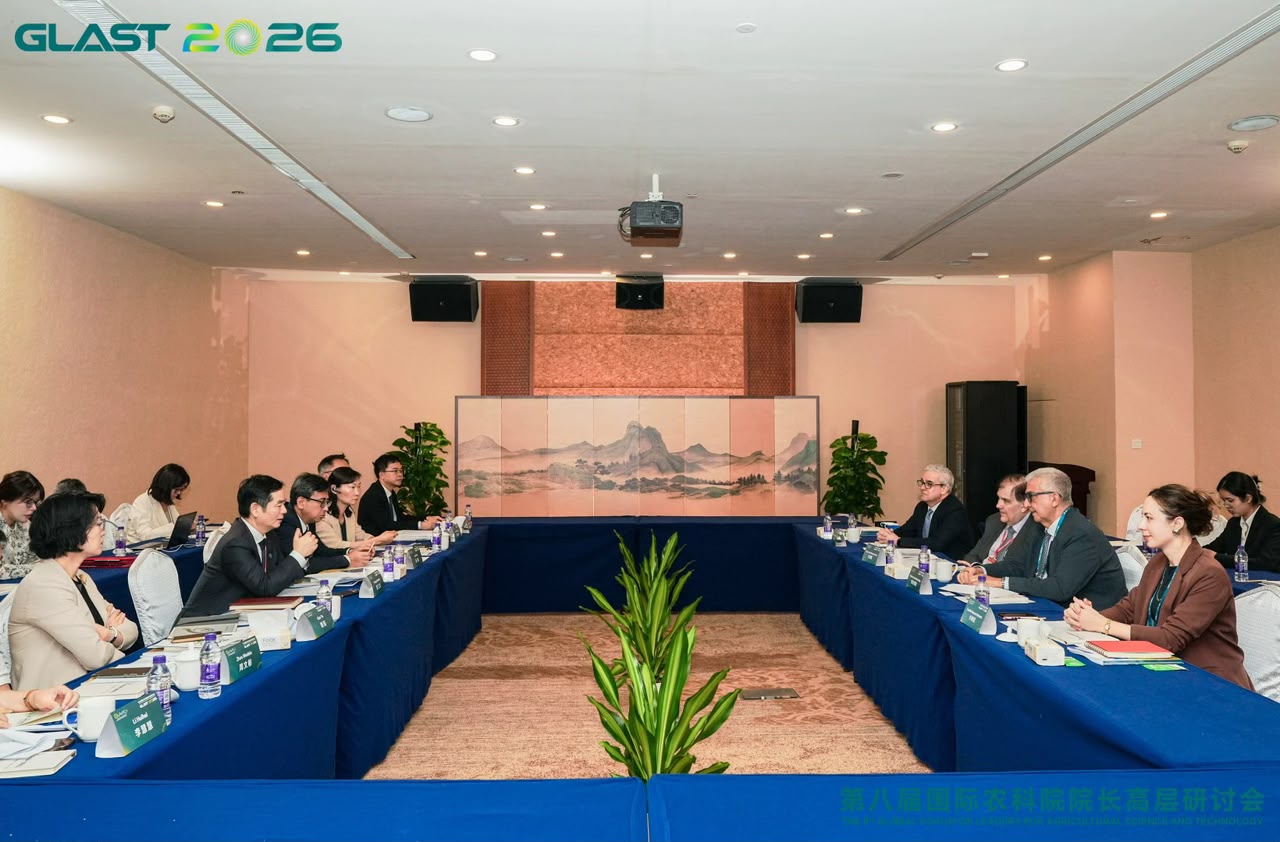
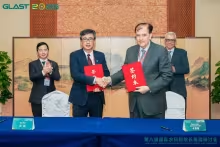
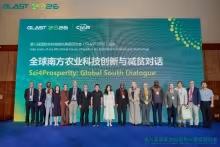
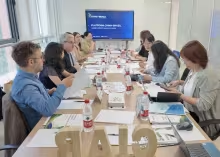
Fundação Getulio Vargas (FGV) and the Center for International Agricultural Research (CIAR) of the Chinese Academy of Agricultural Sciences (CAAS) formalized an amendment to their Memorandum of Understanding (MoU) in November 2026, in Sanya, China. The signing ceremony took place during the 8th Global Forum of Leaders for Agricultural Science and Technology (GLAST 2026), marking another step in strengthening scientific cooperation between Brazil and China.
The amendment was signed by Carlos Ivan Simonsen Leal, President of FGV, and Sun Tan, Vice President of CAAS and Director General of CIAR. The ceremony was witnessed by Huang Sanwen, President of CAAS, and attended by Professor Antônio Carlos Kfouri Aidar, Special Advisor to the FGV Presidency.
First signed in 2024, the MoU has now been extended and its scope broadened, building on an established framework for joint research, academic exchange, and technical cooperation. The amendment reinforces the institutions' commitment to long-term collaboration in areas such as technological innovation, climate and environmental sustainability, green finance, agricultural policy, and the development of more sustainable and resilient agrifood value chains.
The cooperation between FGV and CIAR–CAAS also provides an important institutional foundation for the China–Brazil Platform for Green Agrifood Value Chains, a joint initiative developed in partnership with the International Food Policy Research Institute (IFPRI).
Initially focusing on soybean and beef value chains, the Platform brings together researchers and institutions from both countries to generate scientific evidence, conduct joint analyses, and support policy dialogue on sustainability, agricultural trade, and the transition toward low-carbon production systems.
The expanded agreement further strengthens this collaborative framework, creating opportunities to connect scientific expertise, research capabilities, and perspectives from both countries. Through this cooperation, the institutions aim to advance evidence-based solutions and market-oriented approaches that support agricultural development, environmental sustainability, and mutually beneficial trade between Brazil and China.